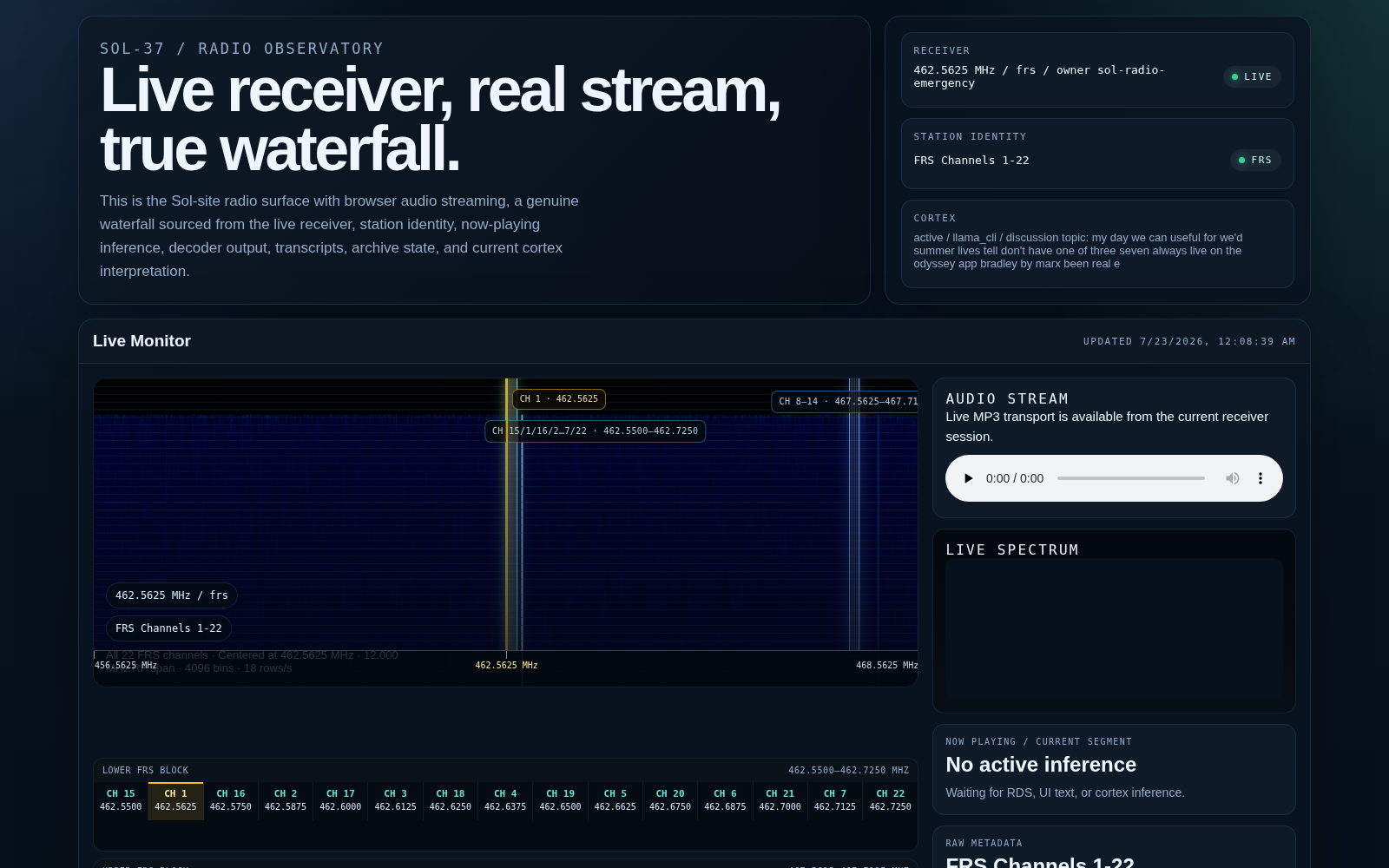
A receive-only HackRF captures its maximum 20 MHz span with Channel 1 as the logical center. A small digital tuning offset keeps the trusted carrier away from the hardware DC spike; the receiver does not scan between FRS channels.
Sol-37 / Radio Observatory
Live receiver, real stream, true waterfall.
This is the Sol-site radio surface with browser audio streaming, a genuine waterfall sourced from the live receiver, station identity, now-playing inference, decoder output, transcripts, archive state, and current cortex interpretation.
Live Monitor
snapshot pendingLower FRS block462.5500–462.7250 MHz
Upper FRS block467.5625–467.7125 MHz
Audio Stream
Audio transport is dormant until explicitly started.
Live Spectrum
Now Playing / Current Segment
No active inference
Waiting for RDS, UI text, or cortex inference.
Raw Metadata
Station unknown
Window title, RDS, and callsign will appear here.
Spectrum Activity
fixed-span observation busEnvironmental RF / Lightning Candidates
pre-gate impulses + bounded IQ and microphone evidenceDetailed Signal Analysis
local LLM hypotheses / measured RF factsReceiver State
session + live transport
Frequency
--
backend n/a
Mode
--
health n/a
Owner
--
started n/a
Transport
idle
stream n/a
Receiver Performance
measured cost + bounded pipeline stateReceiver CPU / Phase--awaiting rolling sample
API / UI CPU--awaiting sample
Model Workers--transcription + inference
CPU Package--temperature sensor
HackRF Input20.0 MS/sChannel 1 centered
Driver Anomalies--hardware counter unavailable
Presentation Clients0waterfall 0 / audio 0
Open Squelches0of 22 channels
Events00 visible
Transcripts00 visible
Live Decoder0history shown separately
Archives0known jobs
Open Audio Demodulators0all 22 RF probes remain live
Audio Drops0queue + playback
Transcription Q0bounded worker
Inference Q0bounded worker
Environmental Q0bounded evidence rings
Signal Analysis Q0local LLM idle
Recent Activity
sanitized event streamRecent Transcripts
filtered monitor + archive + multichannelDecoder State and Evidence
configuration is not detection historyCurrent Decoder Configuration
active observatory topologyLive Detections
current receiver session onlyHistorical Detections
retained evidence from older sessionsDiagnostic / System Events
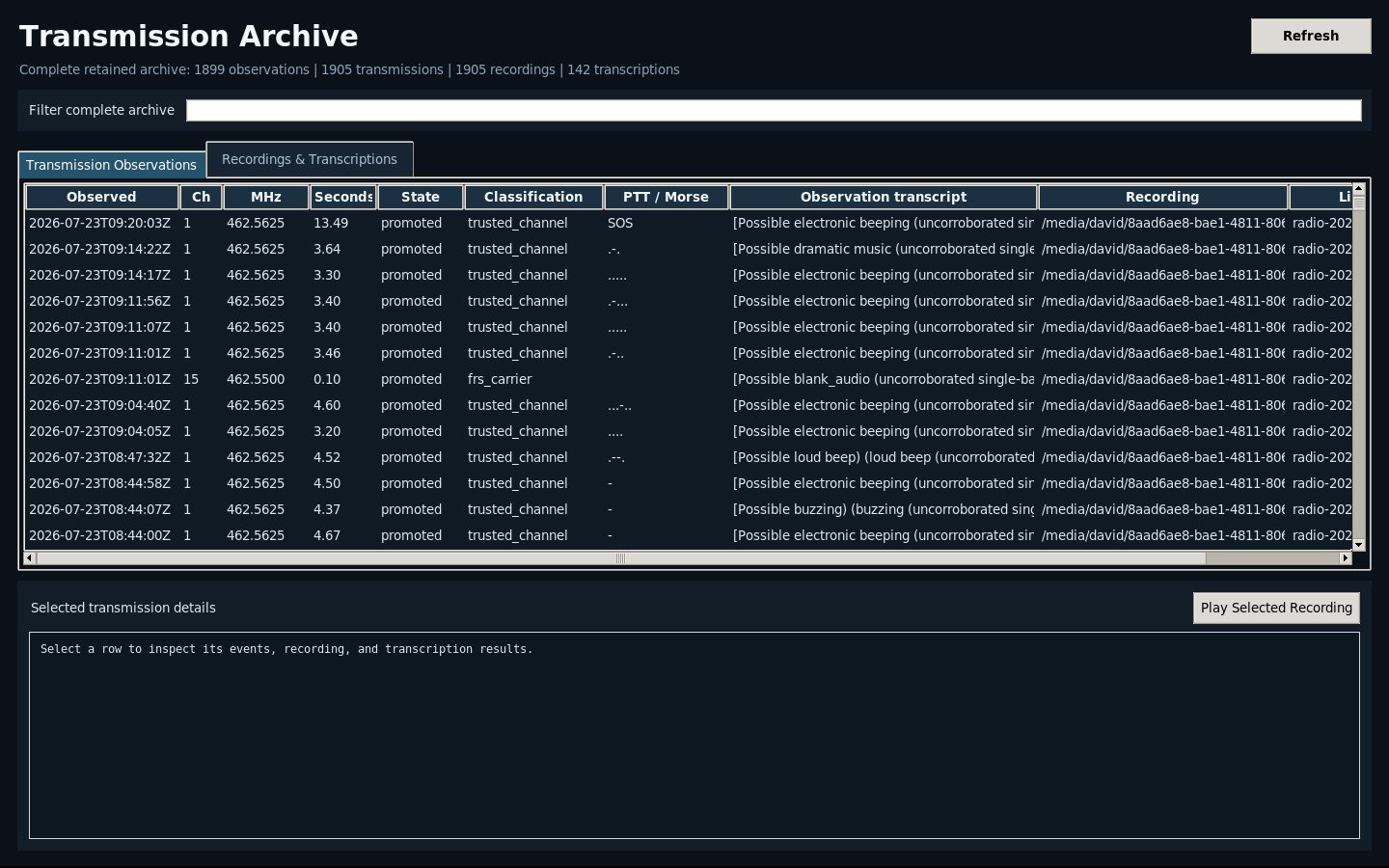
starts, capabilities, and worker stateArchive Jobs
rolling cache and sidecarsMultichannel Jobs
wideband nearby-station captureHow The Observatory Works
observe first · interpret secondAll 22 carrier probes run continuously. Channel 1 audio stays hot; other NFM paths wake on carrier activity and remain open through evidence capture.
A 51.2 µs pre-gate power path covers the full 20 MHz capture. Qualified events retain 0.4 seconds of aliased temporal IQ; RF-only identification is complete without microphones, while any available acoustic correlation remains optional secondary evidence.
Candidate transcripts, descriptive audio, 50 Hz RF edge timing, completed-WAV envelope recovery, deterministic rules, and local-model reconciliation describe what happened. Per-press release chimes terminate PTT holds but never become Morse symbols.
Only sufficient evidence becomes an incident. A single trusted PTT is preserved without a cascade; repeated signaling, voice, or SOS can escalate.
Phase 0 Performance Gate
stability before expansionThe lower and upper FRS blocks are decimated before individual channel power detection. Channel 1 remains continuously demodulated for trusted-call latency.
Non-trusted NFM paths and model workers wake on evidence. Waterfall delivery follows viewport visibility, while browser audio requires explicit playback and selectively lifts weak voice frames without raising the already-limited static bed.
The accepted Phase 0 reference is 3.561 cores. Live cost is labeled STARTUP, STEADY, or DEGRADED so a restart spike is not presented as a steady-state result.
Alert Ladder
evidence determines responseRecorded and available to the live monitor. Short non-trusted noise does not create an immediate prompt or phone reminder.
Raises one durable local alert and one staged phone update with no repeat schedule. Acknowledgment cancels pending reminders transactionally; atomic scheduler leases prevent restart duplicates. An explicit high-confidence spoken test appears first, then may close after a seven-second minimum.
Multiple verified holds receive bounded reminders. SOS uses a tempo-independent 1:2 test: dots are near 1/12 and dashes near 1/6 of total keyed time, with exactly nine ordered holds, separated clusters, high confidence, and the indexed release chimes. The ninth chime closes the sequence and preserves one protected combined WAV. Operator intent alone never creates an SOS decode.
System Views
live surface + retained evidence