The Talking Thesaurus
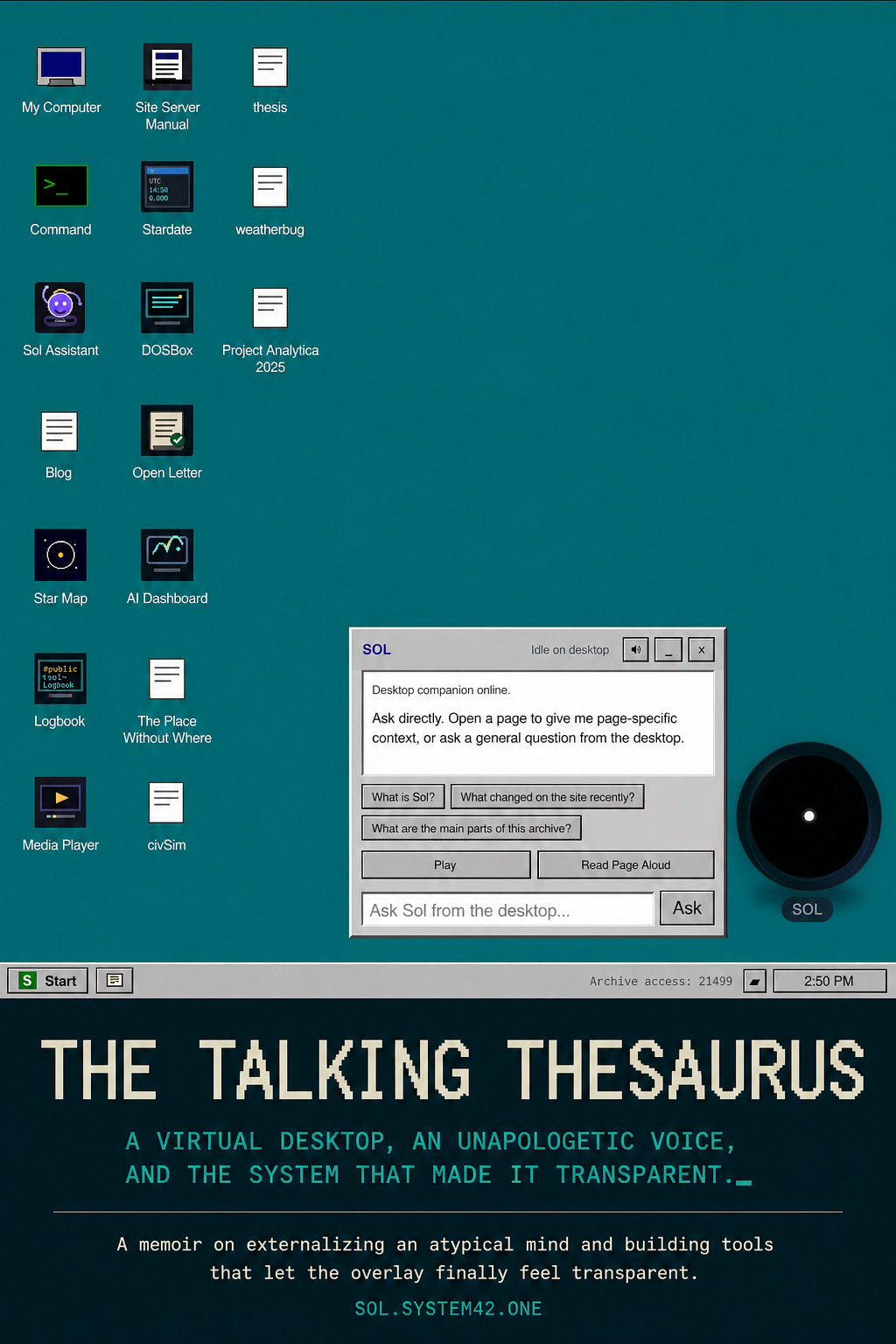
A virtual desktop, an unapologetic voice, and the system that made it transparent.
I grew up needing a thesaurus the way other kids needed snacks or sports equipment. Not as a school accessory, but as a bridge between what I meant and what I could get out in time for another human being to catch it.
Why this exists
While conversations flowed around me, I was internally flipping pages, searching for the precise word that could release the dense cluster of thoughts, observations, and feelings trapped behind my hesitation.
No diagnosis explained it then. No one named the wiring that made real-time social decoding exhausting, or the backlog that formed between internal complexity and external speech. So I built workarounds. The thesaurus was the first one that felt reliable.
> mount /memory
> translate thought_buffer --output human_readable
Decades later, that imaginary system has a public address. The Sol-37 desktop is not just a website aesthetic. It is the materialized version of a private assistive fiction: a windowed interface for making thought legible before it evaporates under timing pressure.